Sarah Theodosia and the Hall family
- This page can also be found on the HMW static site at https://hmwilson.archives.org.au/items/352.html

· Homepage · Tree · Photos · Archive items · Military service · Graves · Storage locations · Private archives ·

| Title: | Sarah Theodosia and the Hall family |
|---|---|
| Identifier: | archives.org.au/STHF |
| Parent item: | |
| Storage location: | SW |
| Date: | |
| Authors: | Helen Margaret Wilson (née Hall) |
| Source: | |
| Format and extent: | |
| License: | © Copyright. The authors of this item reserve all rights. |
| Related people: | Sarah Theodosia Hall (née Branson) · Henry Edward Hall |
| Related places: | Halls Head (create) · Mandurah (create) · Shackerstone |
| Keywords: | H.M. Wilson Archives · books (create) |
| Description: | A 43-page book/pamphlet about the Hall family in England and the Swan River Colony. |
Is also at https://archive.org/details/HMW352
-
-
-
-
-
-
-
-
-
-
-
-
-
-
-
-
-
-
-
-
 Cropped
 -
-
-
-
-
-
-
-
-
-
-
-
-
-
-
-
-
-
-
-
-
-
-
-
-
 Cropped
 -
-
-
-
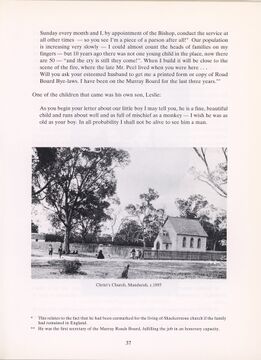
-
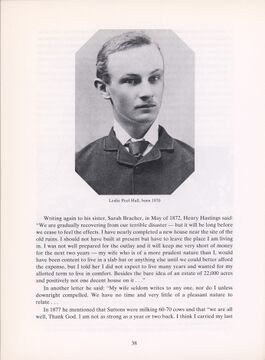
-
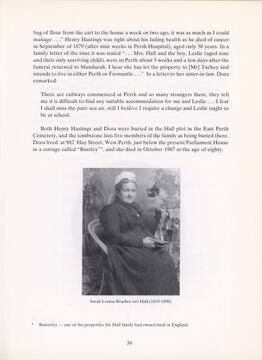
-
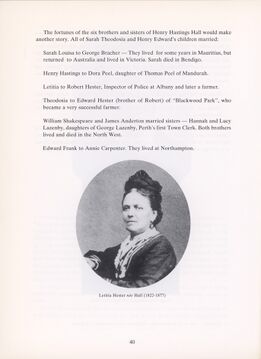
-
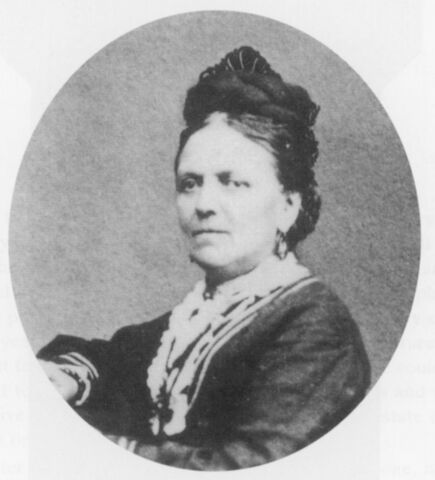 Cropped
 -
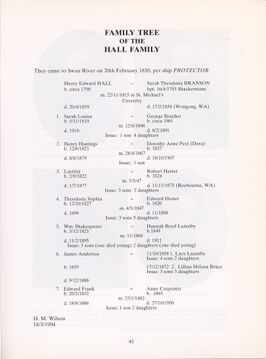
-
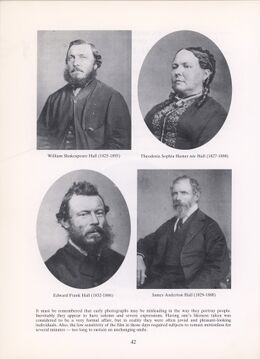
-
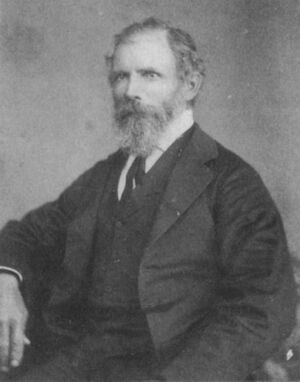 Cropped
 -
-
-

-


Transcription
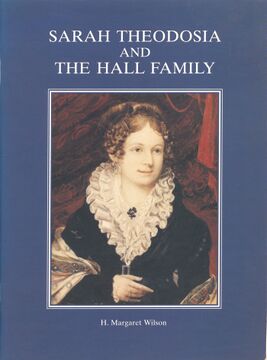
SARAH THEODOSIA AND
THE HALL FAMILY
H. Margaret Wilson
Cover: Sarah Theodosia Hall (née Branson)
Bpt. April 1793
D. Feb. 1858
She was an early pioneer of Swan River and Mandurah.
SARAH THEODOSIA
AND
THE HALL FAMILY
It has always been my intention to remain in the colony
under all circumstances. I wish my young family to feel a
growing interest in its prosperity.
Henry Edward Hall, 1833
H. Margaret Wilson
Published by the author
Perth
1994
METRIC CONVERSION
1 foot 0.305 metre
1 yard 0.914 metre
1 mile 1.61 kilometres 1 nautical mile 1.85 kilometres ] acre 0.405 hectares 1 pound 0.454 kilograms 1 ton 1.02 tonnes
1 horsepower 0.746 kilowatt
STERLING CURRENCY CONVERSION
1/- = 10¢
20/- = £]
£1 = §2
© H. Margaret Wilson 1994
First published by H. Margaret Wilson,
Perth, Western Australia, 1994.
This book is copyright. Apart from any fair dealing for the purpose of private study, research, criticism
or review, as permitted under the Copyright Act, no part may be reproduced by any process without
written permission. Enquiries should be made to the publisher.
Sarah Theodosia and the Hall Family
ISBN 0 646 18397 4
For
Constance
and
Joan
ACKNOWLEDGEMENTS
It is one thing to write a book; it is another to publish. I am indebted to Ronald
Richards for his encouragement and publishing expertise, which has enabled this
brief history of the Hall family and Halls’ Cottage, Mandurah, to be made available
to visitors and others interested in the history of Western Australia.
PREFACE
Quite an amount has been written about people who came to the Swan River
colony in the first years of white settlement. They range from the seven main
families who allegedly held the fortunes of many of the other settlers in their
financial palms; to the proverbial “rags to riches” section who rose from being
servants to masters; and to the spectacularly unsuccessful such as Thomas Peel. This
booklet tells a little about one family on whom fortune did not smile but whose
story, nevertheless, is worth the telling — it concerns my own family of Hall, who
built Halls’ Cottage at Mandurah in 1831. Due to homestead fires in succeeding
generations and the loss of the family diaries and many of their documents, it has
taken some twenty years of painstaking piecing together of clues to outline the
major events described in the pages which follow.
Sarah Theodosia and Henry Edward Hall brought three sons and three daughters with them from England in 1830, and another son was born at Fremantle in 1832. Of the seven children, the William Shakespeare line somehow saved most letters and artifacts. The bulk of these have now been spread over five museums in Western Australia — Perth, Fremantle, Stirling House, University of Western Australia and Cossack — as well as the Battye Library. It is pleasing to note that the greater part of the display in the Shakespeare Hall Museum of Social History at the old port of Cossack in the North West of the state is made up of items donated by descendants of William Shakespeare Hall.
H.M.W.
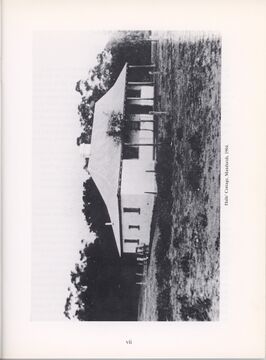
ABOUT HALLS’ COTTAGE
Mr and Mrs John Oldham, well known Western Australian heritage architects,
have studied the architectural features of Halls’ Cottage and reported:
The Henry Hall Cottage at Mandurah is typical of the very earliest dwellings
constructed by pioneer settlers in the first two decades after the Colony was
founded. It is a five-roomed cottage of the utmost simplicity of construction and
design . . . and was originally roofed with hand-split shingles. From the lines of
the roof at the north end it would appear that the intention was to extend the
cottage in this direction . . . Although many of our earliest settlers were like the
original owner of this house — men of education, culture and good breeding,
and often coming from country houses of some size and granduer in England —
the first dwellings they erected in Western Australia were, perforce, very small,
simple and rough. Conditions of life here were primitive in the extreme. There
were no roads, only sandy tracks. No quarries or stone masons to cut building
stone. No timber mills to treat timber for fine joinery. No glass factories, nor
factories to make other house fittings, roof tiles and so on. Any labour was in
short supply and skilled labour practically non-existent . . . So the early settlers
had to build their houses as best they could devise with the scant unskilled
labour available, and using whatever natural materials that lay close at hand.
Men of financial substance had often expended most of their fortune in
equipping themselves with stock and agricultural equipment in order to be
eligibile for large land grants on arrival in the Colony; and even those who still
had ready cash found themselves in the same position as less wealthy pioneers
because of these difficulties. The Henry Edward Hall Cottage like so many of a
similar period is, therefore, constructed of local limestone . . .
vi
“7061 ‘Yeinpuey ‘93100 SHEH
Vii
SARAH THEODOSIA
AND
THE HALL FAMILY
It was well before dawn on a cold April morning in 1860 when Henry Hastings
Hall left the Wongong farm-house to go to the south-east corner of the garden, at
the end of the great vine trellis. It was 3 o’clock, and nothing was yet stirring —
silent and eerie with only the dim light of the lantern. He followed the well defined
path where his father had so often walked to the grave of his beloved wife, Sarah
Theodosia, since her death just two years earlier. Now his father too was dead and
the farm sold, and because of this he could not bear to leave her last resting place
in the hands of strangers. And so, his mind already made up, he began to dig.
Ten hours later, his task completed, he turned the bullock dray homewards from the East Perth Cemetery, and began the slow journey back to Wongong. In the evening, despite his fatigue, he took up his quill and wrote:
Today I performed the melancholy task of removing my poor Mother’s coffin
from Wongong to the Perth Cemetery. I started at 3 o’clock in the morning and
didn't get it over until 1 o'clock noon, she now rests at the side of our other dear
parent. I shall not think our duty towards them is done until we have erected a
nice marble slab to their memory — it is the last respect we can pay them ere we
ourselves enter on Eternity.
This was the end of the story of Sarah Theodosia and Henry Edward Hall, who
had arrived at the Swan River colony in February 1830, but eight months after
Captain Stirling.
To explain the story of Sarah Theodosia and the Hall family generally the task is somewhat simplified because she and Henry Edward were first cousins — he was the son of Henry Edward Hall, the elder, and she was the daughter of that man's sister, Charlotte Catharina Hall, who married Thomas Branson, a farmer of Newton Burgoland, Leicestershire.
The recorded history of the Halls goes back to the 1550s to one John Hall who died in 1616, leaving his estate to his wife and children under a quaintly worded will — the major portion going to his son William. It was this William Hall who laid the foundation for the subsequent prosperity of the family. In 1628 he purchased a substantial estate in the village of Shackerstone in Leicestershire. This property was a very old one, with recorded ownership going back to the thirteenth century, and even as late as the early nineteenth century having the remains of a moat and small castle or other type of fortified building still discernible. Thus it was that in the fullness of time and several generations later, Henry Edward Hall (the second) inherited at the age of seven years, from his bachelor Great Uncle, Thomas Strong
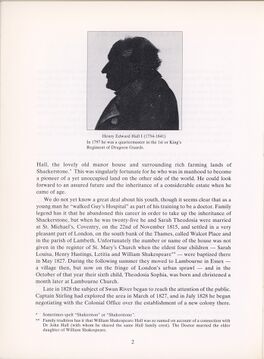
Henry Edward Hall I (1754-1841)
In 1797 he was a quartermaster in the 1st or King's
Regiment of Dragoon Guards.
Hall, the lovely old manor house and surrounding rich farming lands of
Shackerstone." This was singularly fortunate for he who was in manhood to become
a pioneer of a yet unoccupied land on the other side of the world. He could look
forward to an assured future and the inheritance of a considerable estate when he
came of age.
We do not yet know a great deal about his youth, though it seems clear that as a young man he “walked Guy's Hospital" as part of his training to be a doctor. Family legend has it that he abandoned this career in order to take up the inheritance of Shackerstone, but when he was twenty-five he and Sarah Theodosia were married at St. Michael's, Coventry, on the 22nd of November 1815, and settled in a very pleasant part of London, on the south bank of the Thames, called Walcot Place and in the parish of Lambeth. Unfortunately the number or name of the house was not given in the register of St. Mary's Church when the eldest four children — Sarah Louisa, Henry Hastings, Letitia and William Shakespeare"* — were baptized there in May 1827. During the following summer they moved to Lambourne in Essex — a village then, but now on the fringe of London's urban sprawl — and in the October of that year their sixth child, Theodosia Sophia, was born and christened a month later at Lambourne Church.
Late in 1828 the subject of Swan River began to reach the attention of the public. Captain Stirling had explored the area in March of 1827, and in July 1828 he began negotiating with the Colonial Office over the establishment of a new colony there.
- Sometimes spelt “Shakerston” or “Shakerstone”.
- Family tradition has it that William Shakespeare Hall was so named on account of a connection with
Dr John Hall (with whom he shared the same Hall family crest). The Doctor married the elder daughter of William Shakespeare.
We do not know how Henry Edward heard of the scheme — there are tantalizingly
cryptic entries in a brief diary of his in 1826 in which he not only records the loss of
a little two year old daughter (called Sarah Theodosia after her mother) who died
in the June and was interred in the Hall vault under the Communion Table at
Shackerstone Church, but on Wednesday October 4th. 1826 he “call'd on Mr. Peel,
Mr. Harman and Mr. South”, and the name of “Peel” is mentioned the following
day and again on the 13th. of that month. One cannot help wondering, which Mr.
Peel. It does appear (not surprisingly) that a number of the early settlers of the
Swan were known to each other before they left their homeland. Presumably Henry
Edward was one of the many people who were attracted by Stirling’s lyrical
descriptions of the land and the climate of South Western Australia, and by the
generous terms which the Colonial Office was offering to British people who were
willing to invest in the scheme. Obviously these factors must have contributed to
Henry Edward coming to the momentous decision to forsake England and to invest
his money in a far off country. Why he should ever have considered emigrating in
the first place needs a little more explanation. At the time there was talk of
repealing the Corn Laws which, if done, was thought likely to cause social chaos and
financial disaster to rural England. In addition, Britain had only recently emerged
from the very long conflict with Napoleon, and the initial postwar boom, then the
following economic depression with its associated political unrest and rural rioting,
left many Englishmen believing that the country was on the verge of revolution.
Cashing in one’s assets and removing to a new colony which seemed to promise
enormous economic returns therefore seemed like a very good idea.
The first letter of Henry Edward’s on this topic that has survived is to Twiss of the Colonial Office and it impresses as a most reasoned and practical approach from anyone contemplating emigration. The fact remains that Henry Edward (aged 38), Sarah Theodosia (aged 27) and the six children embarked in October 1829 on the recently built ship Protector, 380 tons, 109 feet long and with accommodation for 90 passengers, the family occupying eight of the cabin berths of which there were only twenty. Other cabin passengers included the names of Darby, Foley, Phillips, Churchman, Earl, Bickley, and Lieutenant and Mrs Birkett. Churchman’s Brook and Bickley Valley must find origin from here. There were 43 steerage passengers, which included ten servants and apprentices for the Halls.
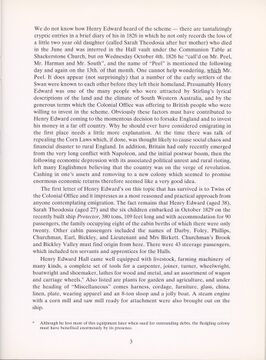
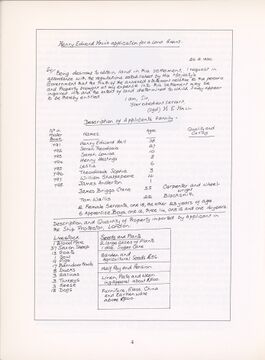
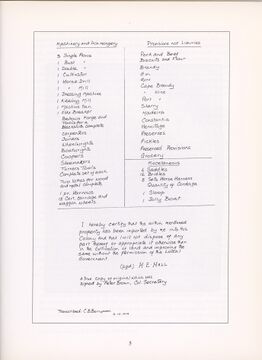
Henry Edward Hall came well equipped with livestock, farming machinery of many kinds, a complete set of tools for a carpenter, joiner, turner, wheelwright, boatwright and shoemaker, lathes for wood and metal, and an assortment of wagon and carriage wheels.* Also listed are plants for garden and agriculture, and under the heading of “Miscellaneous” comes harness, cordage, furniture, glass, china, linen, plate, wearing apparel and an 8-ton sloop and a jolly boat. A steam engine with a corn mill and saw mill ready for attachment were also brought out on the ship.
- Although he lost most of this equipment later when sued for outstanding debts, the fledgling colony
must have benefited enormously by its presence.
3
Henr Eduard FALLS a Jicahon füY a Lara Erant.
26. 2. 1630.
OI р.
Being desirons Ъ obfain land in his settlement, | request in
accordance with he regulations eslab lished by His Majesty's
Government that the Truth of me annexed s lale went relative 5 The Persons
nse INlo fhis settlement may be
and наган 4 yon ia at my expe
inquived 1А ANA the exent © land determined әд, J
fo e thereby en titled . 1757 | rmined To whith У may appear
/ ам, Sir,
Your obedient 56 rvant
(544) И E Hall
Desarıpfıon Applicants Family -
Дс
Us [
meen қате, pS wes ý m idi
yql. Henry Edward Hall ЕСТІ
742. Sarah Theodosia e
725. Sarak Lousa /O
qay. Henry Hastings 8
yas: letiha 6
796. Theodosia Sophia 3
747. (огам Shakes peare Жі,
748. James Anderlon l
James Briggs Crane 245 Carpenter and whee l-
wright
28, Blacksmith
Tom Wallis
2, Female Servants, one 18, ће other 23 years of 24е ·
els and one І©уёат5.
6 Apprentice Boys, one /2, vee. Ilr, ON
Desc rıpfion and Quantity of Roper ly ımpor led by Applicant 1n
ће Ship Protector, Loder |.
Lweslock. A
Ç eds And Flanis
| Шоғы te Zlarge cases of Plans 37 Saxon Sheep I doz gar Care
(3 Goals i
Garden and
| Leds #56.
.
- Agricul t
17 Barndoor fowls PUSHES
8 Ducks Half fay and fension
5 Galinas - 7
3 Turkeys Linen, Plate and Wear- 3 A In Apparel about Z500.
/ : ;
pea Furniture , Glass, China
and Earthen ware
abore Koo:
machinery and Iron mongery
- Single. Flows
1 Bust v
| Darbe v
| Cultivator
/ Horse Drill
| v ll
| Dressing Machine
| Kibbling ^1!!!
| Machine Fan
| Flax Breaker Bellows Forge and Tools for a Blacksivith complete car penlers Joiners Whee lwrighlS Boatwrigh's Coopers Shoe makers Turners Tools Complete set of each Two lames for wood and relat complete Lp Harrows
ig Cart, cavriage 44 waggon wheels.
Pronsions nor E Gries
Pork and -—
Biscuits and Flour
Brandy
GIA
RUM
Cape Brandy
v Wine
fort v
Sherry
Madeira Constantia Hermitage Preserves
Pickles
Preservecl Provisions Grocere
Miscellaneous
6 Saddles
12, Bridles
8 Sets Horse Harness
Quantity ор Cordage
| Sloop
| Jolly Boat.
I hereby cerhfa that The within mentioned
properly has been imporled by me into this
Colony and that [will not dis pose of any
part thereof or appropriale if oherwise than
Іт the Cultivation of land and Im provin. the
same wifhout the permission of he Local
Governnent.
(ваау HE Hatt
A frue copy of original Which WAS
Signed by Peter Broun, Col. Secrelary
Transcribed: C. BBerryman
H-10.187Q
9531 Ұ
0
p^
j
M
ds
1.
ud EE =:
Ақы
m
RAE
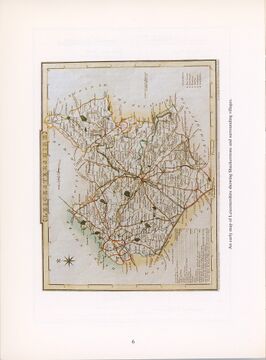
An early map of Leicestershire showing Shackerstone and surrounding villages.
Apparently luxuries were not an allowable item in the computation of property
value for assessment of land grant entitlement, but it is interesting to note that the
list of “provisions not luxuries” included along with the more prosaic groceries,
pork, beef, biscuits, flour, pickles and preserves, a fair quantity of brandy, rum,
Cape brandy, Cape wines, port wine, sherry, madeira, constantia and hermitage.
Onarrival in February 1830 the family had difficulty in finding a place to live in at the tiny settlement of Fremantle, and it may be imagined that it was more in desperation than joy that they bought the hulk of a ship which had been partially wrecked and washed ashore. They moved their belongings into the wreck and made it their home. It must have seemed strange at first to see the fowls leaving their ark at low tide to forage for food ashore.
The Halls therefore had a home of sorts and also had enough to eat. Many others were not so fortunate. A fellow passenger on the Protector, Lieutenant Birkett, wrote to Captain Stirling three weeks after arrival, begging him to expedite his grant and said:
... three times I have visited Perth (without the opportunity of meeting you) 4
nights I passed in the bush . . . I trust it will be seen I have used every possible exertion to effect the removal of my family from this detestable beach of Fremantle where they suffer extremely from the badness of the water, and the vigilant attentions required here for the preservation of property, besides we are losing the season for preparing our land to receive seed. My son, Sir, is so weakened by Dysentery at this moment as to render his services no longer available to us and his mother is well nigh exhausted by excessive anxiety. As to myself, an old campaigner, I disdain to murmur at sustaining an ordinary share of Privations and Difficulties — tis the sufferings of those immediately connected with me can alone make me wince and I feel a conviction that you, Sir, will directly regard my position with the eye of a Husband and Father!
Nearly eight weeks later poor Lieutenant Birkett was telling Captain Stirling of
his further problems, which included the swamping of his flat" after it was loaded,
causing the loss of 2 cwt. of biscuits and other articles. He closed his letter: *. . . but
as it is my first mischance I have encountered here, I must not murmur, especially
since so many around me have suffered infinitely more . . ."
During this time Henry Edward was having troubles enough of his own. On March 19th he made application for his land grant and in the covering letter he said:
Having landed property to a considerable sum at Fremantle which are now
exposed to the weather on the beach I should be much obliged by your allowing
me to select an allotment for the purpose of placing them in a state of greater
security. I beg to observe that I have been prevented from complying with the
regular forms having had the misfortune to lose a flock of saxon sheep which are
now astray.
- А flat-bottomed boat able to traverse shallow water.
7
Incidentally, Henry Edward must have located some of these sheep because in
1839 he battled unsuccessfully with the Government for compensation for five of
them. He detailed the vicissitudes of making two trips to Garden Island and three
to “Rottenest” to finalize the business of taking up two urban allotments at the
proposed townsite of Kingston on Rottnest, ten acres to the west of that townsite,
as well as a larger selection of 100 acres. He noted:
I sent a fine Saxon Ram which I refused £45 for at the Cape and four Saxon
Ewes, which cost me £10 each exclusive of freight and Seven Goats, the sheep all
died and four of the Goats in consequence of the feed not agreeing with
ruminating animals, the other three Goats died after being removed from the
injury they had received — I had two men and a boat at the island but could not
employ them on improving the land as the boundaries were not to be
ascertained.
This was yet another minor disaster for Henry Edward and a loss he could ill
afford. He lost the whole of the outlay at Rottnest when the Government resumed
the land in 1839.
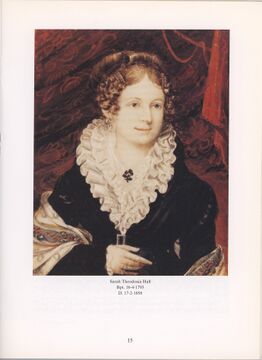
When one looks at Sarah Theodosia’s miniature one sees a slim, attractive woman, with her chestnut hair elaborately styled, wearing a dark, high-waisted gown finished with fine lawn and lace ruffles at the neckline, with a glimpse of a gaily patterned shawl — there are diamond earrings and three finger rings, as well as a brooch. One longs for some written word of hers, expressing her feelings about this period of her life. There she was, with six children between ten years and one (and only the memory of the seventh left behind in a Shackerstone vault), and all around her hardship, sickness and difficulties beyond any reasonable expectation.
Family legend has it that Henry Edward was extremely annoyed by the fact that the Governor did not allocate him a grant of land bordering on the Swan River, and so he decided to explore southwards down the coast in his sloop, and applied for his entitlement to be allocated fifty miles south in the Murray district. He chose most of his grant of 16,594 acres at the mouth of the Harvey River, with the remaining 200 acres on the west bank of the estuary at Mandurah. In April 1831 he engaged William Colvin (at the rate of £30 a year) to be his foreman, and Mrs Colvin (at £12.12.0) as housekeeper, and with six indentured servants proceeded to the Mandurah block to take possession of his grant. They immediately commenced “building, fencing, roadmaking and clearing and cultivating the land”.
In spite of their efforts, the Mandurah project was not a success, and the family and servants suffered a good deal of hardship. Their house was burnt down, and with it all the possessions they had taken to Mandurah with them. The only article saved was a man’s finger ring, which was later found jammed between flagstones on the floor. A mercy was that they had been able to move only about half their effects from Fremantle in the sloop. Then the sloop was wrecked while on a trip to
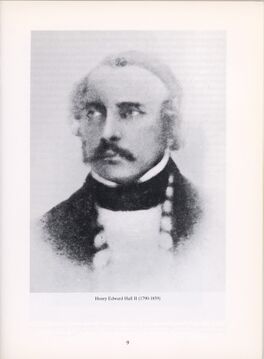
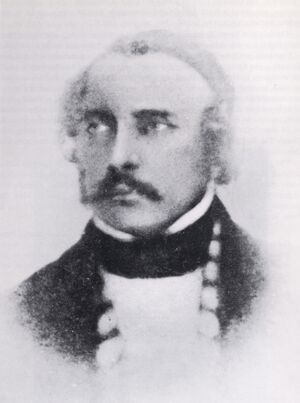
Henry Edward Hall II (1790-1859)
Fremantle, and although they were able to obtain some stores from neighbours, all
business transacted in Perth necessitated a Journey by bullock wagon, since, as said
before, horses could not be kept for long on their land.
The fact that Sarah Theodosia was pregnant at this critical Juncture must have been highly complicating and could have influenced the decision for her to remain in Fremantle, with the children, until after the birth. The records show that Henry Edward applied for more land near Fremantle only three months after he had taken his workforce to Mandurah. There is a letter to the Governor in July 1831 in which he said he made application “to occupy a small valley as a garden for the accommodation of my family... I beg to observe that about a third of the above is already cultivated by me ... my object in applying is to form a small experimental farm convenient for that purpose, by its vicinity to my residence at Fremantle... 12 or 14 acres.” On 2nd February 1832 Edward Frank Hall was born at Fremantle (Sarah Theodosia was 39 years old) and the family now comprised four sons and three daughters.
The following year Sarah Theodosia left in the Cygnet to take the two eldest children, Sarah Louisa and Henry Hastings, to school in England, and to attempt while there to sort out some of the family’s finances. In this latter venture she appears to have been unsuccessful, and in a letter she wrote to “The Rt. Hon. the Secretary for the Colonial Department”, she mentioned Henry Edward’s losses at Swan River and explained:
... under these circumstances, I returned to England to obtain assistance from
the relations and friends I had left to enable us to cultivate our land. From death,
losses in trade and other casualties, which have befallen my friends in my
absence I have been miserably disappointed in this object, and am at last left
without the means of returning to my husband and children.
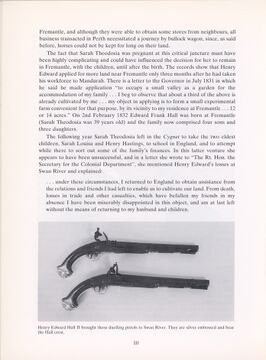
Henry Edward Hall II brought these duelling pistols to Swan River. They are silver embossed and bear
the Hall crest.
10
She must have received help from some quarter, because she returned to the
colony in the Adams in November of 1834 to join her husband at Mandurah. Just
twelve days later the Perth Gazette gave a lengthy report about one of the Hall
children (it was James Anderton, who would have been five) being lost after
watching soldiers there fishing on the sea beach at noon. At 4 a.m. next day Mr
Norcott, two other white men and two natives called Migo and Mollydobbin set out.
The natives walked 22 miles with their eyes constantly fixed on the ground for ten
consecutive hours of tracking before they saw the little boy lying asleep on the
beach, his legs idly washed by the surf. Another hour and he would have perished
as the tide was rapidly coming in. The joy and delight of the Aborigines was said to
be beyond description. All through the long search the natives had apparently
shown great anxiety for his welfare.
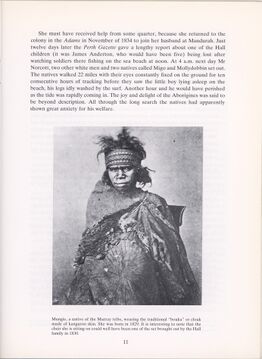
Mungie, a native of the Murray tribe, wearing the traditional “bouka” or cloak
made of kangaroo skin. She was born in 1829. It is interesting to note that the
chair she is sitting on could well have been one of the set brought out by the Hall
family in 1830.
11
Whilst Aborigines are very fond of children at any time, some of their concern
could have been on account of the great regard they had for the child’s father.
Captain Frederick Chidley Irwin in his book called The State and Position of
Western Australia Commonly Called the Swan River Settlement said in 1835:
Mr. Hall is a man of singular firmness and intrepidity. He is residing with his wife
and children and his servants on the left bank of the river, and other settlers
being located on the opposite side. This gentleman has mingled more with the
aborigines in that district and obtained a greater influence over them than any
other settler. He has been known to pass several days together along with them
in the bush, and has thus acquired a considerable knowledge of their habits and
language" A favourite project of his just before the author left the colony was a
fishery which he had actually commenced with the assistance of the natives, and
on one occasion he came to Fremantle along the Coast in his boat manned and
rowed by a party of them. The circumstance whilst it shows the remarkable
influence this settler had acquired, evinces also the docility and quickness of the
natives. Mr. Hall is of commanding appearance, and is generally habited in a
singular costume, of which a conical hat usually worn by Malays forms not the
least conspicuous part.
It does appear to be of significance that Henry Edward took no part at all in
what came to be known as the “Battle of Pinjarra”, when quite a number of natives
were killed by Governor Stirling and his party on the banks of the Murray River at
Pinjarra in October 1834.
Ronald Richards in his book, The Murray District of Western Australia, has quite a deal to say about the ability of succeeding generations of Hall men to understand the Aborigines. They bothered to learn their language and about their customs, and frequently intervened at Government level to right some of the wrongs inflicted on them as a race. In July 1863 Henry Hastings Hall drew his fellow colonists’ attention to the plight of the native people at Mandurah and elsewhere during the winter months, by writing to the /nquirer newspaper:
There appears to me to be a culpable want of commiseration on the part of some
of these gentlemen towards their poor black brethren who are naked and
shivering around them. In our sister Colonies, on the approach of winter, a
blanket is given to every adult native who makes application; but in this district
I do not believe the supply annually doled out would clothe one half of these
poor creatures, who, be it remembered would not need our sympathy had we not
driven the kangaroo from their hunting-grounds. It would be well to bear in
mind that *He doubles his gift who gives in time."
- H. Aubrey Hall, a Great Grandson (1871-1963), left a manuscript entitled “A Partial Vocabularly of
the Ngalooma Aboriginal Tribe", which was published in 1971 by the Australian Institute of Aboriginal Studies.
12
Whilst Sarah Theodosia was settling the children into boarding school in
England, Henry Edward wrote to the Surveyor General regarding two blocks of
land fronting High Street in Fremantle. “I wish them to be vested in Trustees for the
sole use and benefit of Mrs Sarah Theodosia Hall as she intends to lay out some
property of her own in the improvement of the same.” He also referred to the
blocks to the rear of these having been reserved already for other members of his
family which would then “form a square”.
In April of 1834 Thomas Peel’s wife, two daughters and a son arrived from England, complete with 22 pieces of luggage. This fact is mentioned because 33 years later the eldest son of the Halls married Dora Peel and lived on the Hall and Peel land at Mandurah. Mrs Peel’s worst fears of life at Mandurah must have been realized when, within a week of arrival, a large party of Murray River natives attacked Shenton’s Mill on the Swan River at South Perth, ransacking the premises, stealing a quantity of flour and threatening to spear the miller. The Aborigines fled back to their territory at the Murray, where the ringleaders were captured by a party of the military some time later.
It is described in Lady Hasluck’s book on Thomas Peel* how only two months after this incident a native lashed for the part he had played in the robbery, in revenge, took the life of one white man and badly wounded another — the latter seeking shelter and succour from the Peel family. Perhaps it is not to be wondered at that, when funds became available five years later, Mrs Peel and her daughters returned to England, leaving the now fourteen year old son with his father.
Two people had already been speared at Mandurah by the middle of 1832, and there would have been a third had not Henry Edward Hall come along in the nick of time and rescued Sergeant Wood, who had been injured and was vainly trying to defend himself against his attackers. On another occasion Henry Edward was able to defuse a potentially dangerous situation when the soldiers thought that the local Aborigines were massing for an attack on the tiny settlement. He spoke to the natives and found out that they had no ulterior motive in mind; they were gathering for a large corroboree. In addition, he and Thomas Peel spoke in favour of the native Wamba and as a consequence he was not flogged for the part he had played in the ransacking of Shenton’s flour mill at South Perth in April 1834. Even so, Henry Hall had troubles with the Aborigines himself later in the year, and from time to time he too needed protection from the soldiers stationed across the river.
But it wasn’t only the Aborigines that were worrying Henry Edward by now. Despite his initial resources, everything went wrong and his problems escalated with alarming rapidity. With family and servants numbering upwards of eighteen to support, he found himself in financial difficulties with everything going out and nothing coming in as he had confidently anticipated. The horses got a disease called “Chip-chip”, the cattle wouldn’t breed on zamia palm country and, as is now well known, there were mineral deficiencies in the soil (mainly of copper and cobalt). As
- Alexandra Hasluck, Thomas Peel of Swan River (Oxford, 1965).
13
well, his sloop was wrecked and lost on a bank off Fremantle, now charted as
“Hall’s Bank”. Just prior to this Captain McDermott, a merchant of Fremantle, had
offered Hall £300 for a half share for the sloop, which was declined.
Henry Edward requested government rations to help feed his family and servants, due to the general failure of his garden crops at Mandurah. He was granted supplies, but these were cut off when the authorities discovered that the mill he had offered as security on the debt had already been given as security to someone else. He eventually got his rations reinstated, and felt able to write to the Government in June 1834, saying that he had:
. . every reason to feel the ship from England will place me in a more
comfortable situation when I shall be most happy to repay the advance made in
my present unpleasant situation.
In an attempt to assist his finances Henry Edward apparently acted as a
Commission Agent for a Cape Town firm, but when he couldn’t meet the
repayments on time, George Leake (a local solicitor) proceeded against him on
behalf of the Merchants, Jones & Carter, and got judgements for over £1,000. It
would seem likely that Henry Edward was “robbing Peter to pay Paul” in an
attempt to carry on. Word must have got out that he was in difficulties, because he
was summonsed by all who had extended him credit. Leake foreclosed and sold up
by auction not only Henry Edward’s 16,000 acres of land, but his stock, agricultural
implements, furniture, silver, books etc. He must have got low prices and so to
attain the required amount, Leake held a second sale and this time included
harness, casks of provisions, medicines, clothes and a violin — in fact practically
everything involved in the Mandurah development and nearly all that the family
now possessed. This must have caused quite a ripple in the colony because the
Reverend Wittenoom stated at the time that, “. . . Mr. Hall was in the full tide of
prosperity, carrying on a business, as it appeared to me, most successfully.”
Ever an opportunist George Leake bought Hall’s large grant himself, which brought a cry of anguish from Sarah Theodosia in later letters to the Colonial Secretary when she said:
Mr. Hall continued his operations and retained his servants upon the Grant, up
to the year 1836, when he was necessitated to withdraw the hands from the
Establishment, having been plundered and robbed of everything by Mr. George
Leake, through the medium of the Civil Court. The Establishment was not
removed from the Murray until Sepr 1836 when Clare was employed to bring up
some of the furniture goods etc. Mr. Hall still retained possession of the
premises, a person actually residing there with my permission, in one of the
houses erected by Mr. Hall.*
- Probably Halls’ Cottage. The tenant was Thomas Watson, the first ferry-keeper at Mandurah. In
1843 John and Eleanor Sutton were living in Halls’ Cottage. The Sutton family later took over the ferry and operated it for the next twenty years.
14
Sarah Theodosia Hall
Bpt. 16-4-1793
D. 17-2-1858
After all the trauma to which she had been exposed in the collapse of their little
world, it was not to be wondered at that Sarah Theodosia suddenly faltered and
suffered what would now be called a nervous breakdown. Five months later her
mother died in England, quickly followed by the death of Henry Edward’s mother.
The court cases continued — mostly against Henry Edward but some instigated by
him. It had often been thought by descendants that the Halls were unduly involved
in litigation but historians have come to realize that such activities were very
common between business people in that age. Also, the Swan River settlement was
a very small community and the discontent that urged the pioneers from their
homeland not unnaturally manifested itself in intolerance and animosity in the
confined society of this isolated colony. The settlers had pressing immediate
worries, anxieties for their future and the knowledge that it was too late to turn
back. There were endless bickerings and resort to the law, but that was the way of
the times. With the extravagant journalistic terms of the day, the man who was tried
in court for defamation because he called another a blackguard and held a fist to his
nose, might appear in his obituary as a christian gentleman of impeccable rectitude,
beloved and mourned by all. When they pursued trivial irritations into fuming
litigation we should judge their actions against their conditions and their times —
and not by ours. l
Because of lack of positive proof that Henry Edward had trained as a doctor before he inherited Shackerstone not very much has been made of the matter, but in several local court cases the evidence would appear to indicate that he possessed considerable medical skill. In one such case he gave evidence and then asked to be excused, saying: “I must attend my patients; I can make five or six times as much by my practice as by attending in court”. Again in 1837 in the case Tomkins v Arnold the Perth Gazette stated: “. . . the ladies being requested to leave the court Mr. Hall a medical man described the symptoms of the disorder under which the Plaintiff laboured...” This would seem to suggest that the less genteel ladies of Perth sought diversion from more mundane domestic duties to be titillated by the real life drama of the court — and it also indicates that Henry Edward was respected in the colony as a doctor.
About this time Sarah Theodosia became involved in the running of the Perth Hotel, which was in St. George’s Terrace, and this interest was to continue until 1843.
The fact that Henry Hastings Hall was to become of age in June of 1842 must have influenced his father to decide that the only course left him to raise more capital would be to return to England and break the entail on Shackerstone, in which property he had already sold his life interest to finance the Swan River venture.
When Captain Thomas Strong Hall made his will shortly before his death in 1797 it is obvious that he wanted the estate of Shackerstone to continue to be held by the
16
family — he specified that it was to be “entailed”; that is, that it should pass to the
eldest son of Henry Edward and so on. He added a postscript to the will in which
he exhorted his descendants to heed his words:
I most earnestly Recommend the practice of a Profession or trade to every
Relation I shall leave behind me. Idleness being the parent of all that Trane[sic]
of Evil which bring Families to Ruin.
The gallant Captain would not have approved of Henry Edward’s contemplated
action, but he could not accuse him of being an idle man. Henry Edward pressed on
with his plans to return to England and — unusual for the time — he appointed
Sarah Theodosia his legal agent, with power of attorney, and he left Swan River in
the middle of June by the William, reaching Singapore in 14 days. There he spent a
most pleasant four weeks before being able to arrange a passage to England by the
barque Mary Ann which cost him £70. He commenced a letter to his wife at 11 p.m.
on the 26th of August 1841 and said:
I called at Dunkin’s the principal hotel here in order to meet the Captns of the
ships laying here where I met a gentleman Mr Richards — he invited me to his
home and insisted upon my staying with him as long as I remained in Singapore.
I have been extremely comfortable with a first rate table and man servant, a
horse, a chaise and a saddle horse, a house, tho’ under the line, always cool,
numerous sofas in each room, coffee and bath at daylight, a drive or a ride
morning and evening and a covered carriage for the town in the day as much at
command as if it was all my own, and a garden and plantation surrounding the
house in all the luxuriance of tropical vegetation. The roads everywhere as fine
as a gravel walk in a garden, fruit of all kinds in abundance . . . I hope you will
soon receive this as I heard this evening that a vessel will sail tomorrow for
Bally* and Swan River which is the reason of my sitting after all are in bed. Mr
R. is unmarried, about 30 and we have 2 visitors at present, a naval officer and a
Captn who has lately lost his vessel — you would be much pleased with this place
— the great number of horses and carriages — every respectable keeps one or
more, the business carried on amongst 70,000 persons, Mahometans, Hindoos,
Arabs, Malays, Parsees etc., the river covered with boats of all kinds — many are
the only habitations of numerous families, the bay full of ships coming in and
going out with the flags of all nations, the beautiful drives on the beach with
green grass growing to the waters edge intersected with fine gravel roads with
numerous carriages continually passing form a very animated contrast to the
dull sands of Swan River. I shall write again to you before I leave as Mr R. has
kindly undertaken to forward it after my departure — with my sincerest love to
the dear children and yourself. Believe me to remain yours H. E. Hall... I
intend dividing a sheet amongst the dear children at daylight tomorrow. It is now
- “The island of Bali.
17
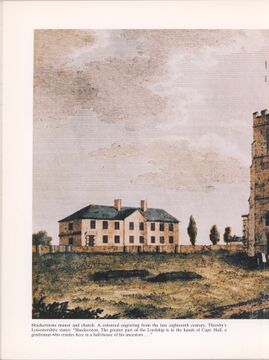
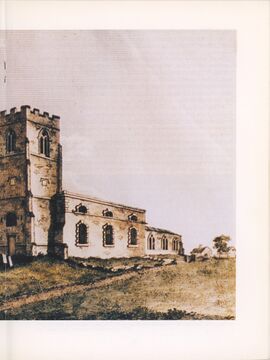
Shackerstone manor and church. A coloured engraving from the late eighteenth century. Throsby’s
Leicestershire states: “Shackerston. The greater part of the Lordship is in the hands of Capt. Hall, a
gentleman who resides here in a hall-house of his ancestors . . .”
2 o'c. [P.S] We had a great deal of sickness aboard the William as soon as we got
into the moist climate of Sumatra but I was so fortunate as to cure all the cases
and escaped myself.
“a very animated contrast to the dull sands of Swan River” indeed! Poor Sarah
Theodosia with the five youngest children to provide for was busy writing to the
Colonial Secretary regarding a licence to sell beer from the premises. She also had
to see to their education. The Rev. John B. Wittenoom, first Colonial Chaplain, had
tutored the older boys for a time, but the continuing education of the children now
must have been a big worry — to say nothing of the expense in an age where there
was no free education.
Within a year Sarah Theodosia received a stunning set-back when she discovered that Governor Hutt, after he took over from Captain Stirling, had set about resuming selections of land wherever he considered the conditions of assignment had not been met. She wanted to rent one of the cottages on their last remaining grant of 200 acres on the south bank at Mandurah to a Mr Watson who was doing some surveying in the area. She was dumbfounded to find that this had been resumed some two years before her husband left for England, but no advice of the fact had been made. To complicate matters further the Governor had included Hall’s name as owner on the Land Returns to London until the year 1841. This began a constant stream of letters, backwards and forwards, between Sarah Theodosia and the Colonial Secretary. Her education, command of words and logical thinking was impressive as she went back step-by-step outlining what had taken place. The whole matter hinged on whether Henry Edward really had furnished a sketch and official application for the 200-acre grant. She reiterated, time after time that, “ ... to my certain knowledge Mr Hall positively did reply to the letter from the Surveyor General regarding the 200 acres . . . and he also sent a sketch indicating and defining the position of the 200 acres." Sarah Theodosia suggested that her husband was unlikely to have neglected replying to the Surveyor General's letter (*willfully and knowingly") when his heavy expense was considered,
in maintaining an Establishment on the said Grant from April 1831 to 1836, a
period of 5 years, the losses he incurred through carrying on the Establishment
independent of the toil and labor himself bestowed upon it . . . After the
foregoing elucidation, I feel persuaded you will perceive the injustice, the
cruelty, and oppression there would be in wresting from Mr Hall’s family (for the
trespass or neglect of the Post Office) the last remaining 200 acres left him in this
colony, and for which [he] had sacrificed so much, and for which he paid so
dearly and that His Excellency the Governor will be induced favourably to
regard this application and permit me as Mr Hall’s agent etc. .. . to make the
selection for him over again and also to take out the Fee Simple again.
20
By return of mail there was a memo signed by Governor Hutt which stated:
- ... the govr cannot recognise Mr Hall’s right to claim the 200 acres now altho’ he
may have paid out money upon the same, he must have known he was doing so at his own risk on Govt property and the time has passed when grants of land without purchase can be obtained by individuals.” Within a few days Sarah Theodosia replied, asking four specific questions regarding the grounds on which His Excellency arrived at his decision which she considered “. . . as most, cruel, most arbitary[sic], most unjust, iniquitous and illegal" — and finally warned him against disposing of the said land until a reply had been received from the Colonial Office, Downing Street, after they had perused the whole case presented by Henry Edward Hall who was still in London. She also sent sworn affidavits of Messrs Welch and Wade. These were returned to her with a reiteration of the previous advice.
Now quite desperate, Sarah Theodosia sought legal aid and a beautifully prepared Memorial was composed with seven supporting affidavits. It was of considerable length and the following are brief quotes from it:
It is indeed hard [that] your Memorialist's husband апа... large family should
be deprived of their natural and undoubted rights merely through the
miscarriage or non delivery of a letter ... my husband was residing for years on
this very grant with an establishment of servants, and took your Memorialist
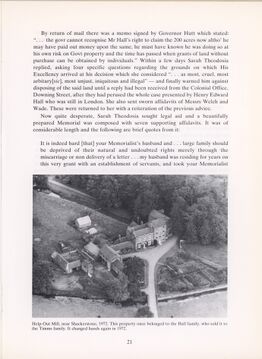
Help-Out Mill, near Shackerstone, 1972. This property once belonged to the Hall family, who sold it to
the Timms family. It changed hands again in 1972.
21
from Fremantle to the Murray River on horseback to view the improvements
which he had effected, and which, trusting to the promises of the Government,
he fondly hoped would be a home-stead for his family connected with his large
grant of 20,000 acres on the Harvey River, wrested from him by Power, the
legality of which he will yet investigate and [is] now on the proper spot for such
a purpose ... that it appears to your Memorialist and many others that it is unfair
to take advantage of a lone woman and large family in the absence of her
husband whose presence in this colony might rectify all seeming mistakes . . .
Your Memorialist . . . leaves it to your Excellency and the British Government
whether her husband is entitled to the land or not . . . and trusts to your
Excellency's sense of Honor[sic] and Justice or to send to her Majesty's
Secretary of State, by whom she believes justice will be awarded...
At last Sarah Theodosia's tenacity was to be rewarded. Five days later the
Colonial Secretary replied: *The Govr is perfectly satisfied from the statement and
documents furnished . . . that Mr Hall has entitled himself . . (о the 200 ac. on Peel
Inlet...” The battle was won.
It needs to be pointed out that this battle put up by Sarah Theodosia, alone, against an authority which was capable of totally breaking the family, showed insight into her basic personality. Women had few rights in those days and it would have taken more than ordinary courage to threaten the Government with Downing Street if all else failed. This is in keeping with her having had blocks of land in her own name and stock about which she would proudly say, *my cattle are looking beautiful". This further reinforces the theory about the crucial part women played in settling Western Australia. There were many such women as Sarah Theodosia, though most would not have had the education and social background which she possessed.
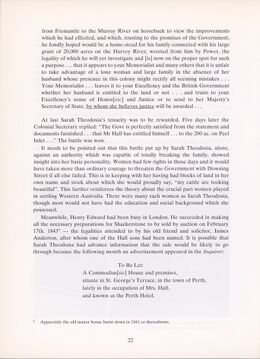
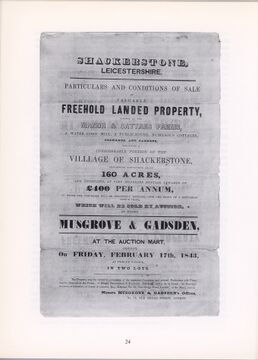
Meanwhile, Henry Edward had been busy in London. He succeeded in making all the necessary preparations for Shackerstone to be sold by auction on February 17th. 1843* — the legalities attended to by his old friend and solicitor, James Anderton, after whom one of the Hall sons had been named. It is possible that Sarah Theodosia had advance information that the sale would be likely to go through because the following month an advertisement appeared in the /nquirer:
To Be Let:
A Commodius[sic] House and premises,
situate in St. George's Terrace, in the town of Perth,
lately in the occupation of Mrs. Hall,
and known as the Perth Hotel.
- Apparently the old manor house burnt down in 1841 or thereabouts.
22
Towards the end of the same year, Henry Hastings (now aged 22 and his
education completed) and Sarah Louisa (now 24) sailed from England in the
Ganges, bringing with them nineteen packages of goods. These were obviously for
re-sale as Henry Hastings advertised on his return to Perth:
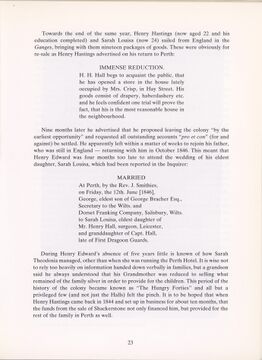
IMMENSE REDUCTION.
H. H. Hall begs to acquaint the public, that he has opened a store in the house lately occupied by Mrs. Crisp, in Hay Street. His goods consist of drapery, haberdashery etc. and he feels confident one trial will prove the fact, that his is the most reasonable house in the neighbourhood.
Nine months later he advertised that he proposed leaving the colony “by the
earliest opportunity” and requested all outstanding accounts “pro et con” (for and
against) be settled. He apparently left within a matter of weeks to rejoin his father,
who was still in England — returning with him in October 1846. This meant that
Henry Edward was four months too late to attend the wedding of his eldest
daughter, Sarah Louisa, which had been reported in the Inquirer:
MARRIED
At Perth, by the Rev. J. Smithies,
on Friday, the 12th. June [1846],
George, eldest son of George Bracher Esq.,
Secretary to the Wilts. and
Dorset Franking Company, Salisbury, Wilts.
to Sarah Louisa, eldest daughter of
Mr. Henry Hall, surgeon, Leicester,
and granddaughter of Capt. Hall,
late of First Dragoon Guards.
During Henry Edward's absence of five years little is known of how Sarah
Theodosia managed, other than when she was running the Perth Hotel. It is wise not
to rely too heavily on information handed down verbally in families, but a grandson
said he always understood that his Grandmother was reduced to selling what
remained of the family silver in order to provide for the children. This period of the
history of the colony became known as “The Hungry Forties” and all but a
privileged few (and not just the Halls) felt the pinch. It is to be hoped that when
Henry Hastings came back in 1844 and set up in business for about ten months, that
the funds from the sale of Shackerstone not only financed him, but provided for the
rest of the family in Perth as well.
23
By 1843 the eldest son, Henry Hastings, had come of age. He had originally been
intended for the church, and to take up the living of Shackerstone, but apparently
declined Holy Orders and instead assisted his father to break the entail on the
estate, which he had now sold for £15.000. This sum had been reduced by half by the
time Henry Edward and Henry Hastings returned to W.A., for £6,000 was needed
to pay the former’s debts, and he had lived more than comfortably during his stay
in England; then — so legend has it — father and son enjoyed the fashionable
Grand Tour of the Continent, which apparently cost £1,000 more.
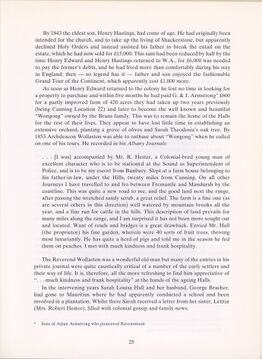
As soon as Henry Edward returned to the colony he lost no time in looking for a property to purchase and within five months he had paid G. & J. Armstrong” £600 for a partly improved farm of 420 acres they had taken up two years previously (being Canning Location 22) and later to become the well known and beautiful “Wongong” owned by the Bruns family. This was to remain the home of the Halls for the rest of their lives. They appear to have lost little time in establishing an extensive orchard, planting a grove of olives and Sarah Theodosia's oak tree. By 1853 Archdeacon Wollaston was able to enthuse about *Wongong" when he called on one of his tours. He recorded in his A/bany Journals:
. . . [I was] accompanied by Mr. R. Hester, a Colonial-bred young man of
excellent character who is to be stationed at the Sound as Superintendent of
Police, and is to be my escort from Bunbury. Slept at a farm house belonging to
his father-in-law, under the Hills, twenty miles from Canning. On all other
Journeys I have travelled to and fro between Fremantle and Mandurah by the
coastline. This was quite a new road to me, and the good land next the range,
after passing the wretched sandy scrub, a great relief. The farm is a fine one (as
are several others in this direction) well watered by mountain brooks all the
year, and a fine run for cattle in the hills. This description of land prevails for
many miles along the range, and I am surprised it has not been more sought out
and located. Want of roads and bridges is a great drawback. Envied Mr. Hall
(the proprietor) his fine garden, wherein were 40 sorts of fruit trees, thriving
most luxuriantly. He has quite a herd of pigs and told me in the season he fed
them on peaches. I met with much kindness and frank hospitality.
The Reverend Wollaston was a wonderful old man but many of the entries in his
private journal were quite caustically critical of a number of the early settlers and
their way of life. It is, therefore, all the more refreshing to find him appreciative of
- ...much kindness and frank hospitality" at the hands of the ageing Halls.
In the intervening years Sarah Louisa Hall and her husband, George Bracher, had gone to Mauritius where he had apparently conducted a school and been involved in a plantation. Whilst there Sarah received a letter from her sister, Letitia (Mrs. Robert Hester), filled with colonial gossip and family news:
- Sons of Adam Armstrong who pioneered Ravenswood.
25
I must tell you something about the farm, as far as I can judge they are going
along very comfortably, but have been put back by an accident that occurred the
other day [of] which I will give Papa’s own description . . . He says, I’m sorry to
inform you that immediately after a severe storm on Friday the 30th. June [1849]
about 5 o’clock in the evening our chimney fell through the roof and completely
smashed the Dining Table. Mama was in the room alone and had just moved out
of the place [where it fell]. I had left the room a few minutes before and where
I was sitting the place was covered with the fragments, where you usually sat the
place was occupied by about 50 cubic feet of solid clay, had it been a little later
we should all have been in at tea and from the manner in which it fell it would
have been impossible for more than one of the family to have escaped. Under
the circumstances it is one of the most miraculous interpositions of the Divine
providence that I ever witnessed. We are now sitting under the canopy of
Heaven. Dear Mama is very unwell as she has not yet recovered from the shock
she received. We may all be thankful that it was not worse. I scarcely know how
to be thankful enough for such sparing mercy...
You will think we ought to be more careful of the way in which we live seeing that we know not what a day may bring forth. You and I had little thought when we had seen Mr. G. Leake at his cellar looking for the good things of this world that he was to be allowed to care for them so short a time, he was called to answer for all he had done in the flesh on 28th. June* Mr. S. Moore followed him [George Leake] on the 7th. inst... . and Bunbury has not been spared, the gay, the happy Mrs. Sillifant was then a maid, a bride, and a corpse in less than six months — she died about a fortnight since. Theodosia tells me her sufferings were dreadful, poor thing she was 2 months in the family мау... I have been interesting Miss Barrett in knitting lately, I hope sometime or other to be able to send my dear [little] Fanny some to sew on the bottom of her pantaloons . . . many thanks for the Воа** I like it much better than the colonial fur, it has been very much admired...
In 1852 William Shakespeare Hall and his brother Anderton went to the
Victorian Diggings — to be joined later by Henry Hastings. Anderton did not stay
long, but Wm. Shakespeare remained for eight, seemingly fruitless, years. Several
letters from the Hall boys were published in the Perth papers. An extract from one
read:
Bendigo, Victoria, December 15, 1853
My youngest brother will soon leave us, but the other members of my party are
determined to remain here until they do get something worth returning with.
One of my brothers, F. Hester, and Symmons, who went to Ballarat, did no good
Indicating perhaps that the Halls had not forgiven him for the part he had played in their family’s
misfortunes during the early years.
- A lady’s long fur or feather throat wrap.
26
there, the two former came back a few days since, but S. preferred remaining.
Harris and Clifton have been trying the deep sinking in the Eureka (Ballarat),
one claim they bottomed at 102 feet; a blank after months of labour, this I
believe has decided them on returning to the Swan very shortly. Wills has closed
his speculations on the diggings and is now either in Melbourne or Adelaide.
Affairs are going on here smoothly enough, except that some of the diggers seem
determined to oppose the operations of the new “Bill for the Gold Fields”. I
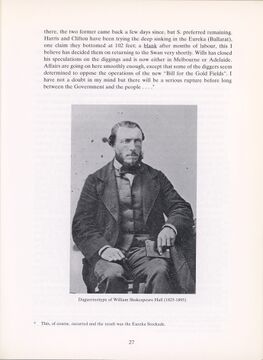
have not a doubt in my mind but there will be a serious rupture before long
between the Government and the people... .*
Daguerreotype of William Shakespeare Hall (1825-1895)
This, of course, occurred and the result was the Eureka Stockade.
27
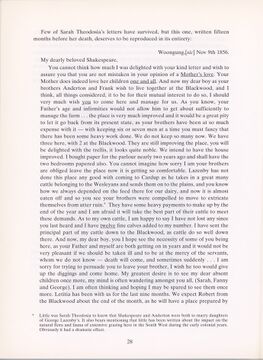
Few of Sarah Theodosia’s letters have survived, but this one, written fifteen
months before her death, deserves to be reproduced in its entirety:
Woongung,|sic] Nov 9th 1856.
My dearly beloved Shakespeare,
You cannot think how much I was delighted with your kind letter and wish to assure you that you are not mistaken in your opinion of a Mother’s love. Your Mother does indeed love her children one and all. And now my dear boy as your brothers Anderton and Frank wish to live together at the Blackwood, and I think, all things considered, it to be for their mutual interest to do so, I should very much wish you to come here and manage for us. As you know, your Father’s age and infirmities would not allow him to get about sufficiently to manage the farm... the place is very much improved and it would be a great pity to let it go back from its present state, as your brothers have been at so much expense with it — with keeping six or seven men at a time you must fancy that there has been some heavy work done. We do not keep so many now. We have three here, with 2 at the Blackwood. They are still improving the place, you will be delighted with the trellis, it looks quite noble. We intend to have the house improved. I bought paper for the parlour nearly two years ago and shall have the two bedrooms papered also. You cannot imagine how sorry I am your brothers are obliged leave the place now it is getting so comfortable. Lazenby has not done this place any good with coming to Cardup as he takes in a great many cattle belonging to the Wesleyans and sends them on to the plains, and you know how we always depended on the feed there for our dairy, and now it is almost eaten off and so you see your brothers were compelled to move to extricate themselves from utter ruin.* They have some heavy payments to make up by the end of the year and I am afraid it will take the best part of their cattle to meet these demands. As to my own cattle, I am happy to say I have not lost any since you last heard and I have twelve fine calves added to my number. I have sent the principal part of my cattle down to the Blackwood, as cattle do so well down there. And now, my dear boy, you I hope see the necessity of some of you being here, as your Father and myself are both getting on in years and it would not be very pleasant if we should be taken ill and to be at the mercy of the servants, whom we do not know — death will come, and sometimes suddenly ... I am sorry for trying to persuade you to leave your brother, I wish he too would give up the diggings and come home. My greatest desire is to see my dear absent children once more, my mind is often wandering amongst you all, (Sarah, Fanny and George). I am often thinking and hoping I may be spared to see them once more. Letitia has been with us for the last nine months. We expect Robert from the Blackwood about the end of the month, as he will have a place prepared by
- Little was Sarah Theodosia to know that Shakespeare and Anderton were both to marry daughters
of George Lazenby’s. It also bears mentioning that little has been written about the impact on the natural flora and fauna of extensive grazing here in the South West during the early colonial years. Obviously it had a dramatic effect.
28
that time, I am sorry Letitia is going so far away, and more than all I shall lose
my dear little Freddie, he is a very nice little boy, very good and exceedingly
forward for his age, and can almost run, and prattles very much.
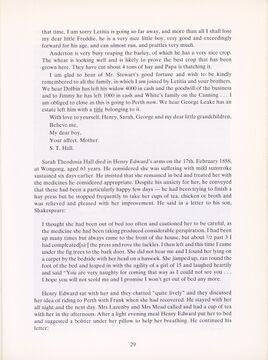
Anderton is very busy reaping the barley, of which he has a very nice crop. The wheat is looking well and is likely to prove the best crop that has been grown here. They have cut about 4 tons of hay and Papa is thatching it.
I am glad to hear of Mr. Stewart’s good fortune and wish to be kindly remembered to all the family, in which I am joined by Letitia and your brothers. We hear Dolbin has left his widow 4000 in cash and the goodwill of the business and to Jimmy he has left 1000 in cash and White's family on the Canning . . . I am obliged to close as this is going to Perth now. We hear George Leake has an estate left him with a title belonging to it.
With love to yourself, Henry, Sarah, George and my dear little grandchildren,
Believe me,
My dear boy,
Your affect. Mother.
S. T. Hall.
Sarah Theodosia Hall died in Henry Edward’s arms on the 17th. February 1858,
at Wongong, aged 63 years. He considered she was suffering with mild sunstroke
sustained six days earlier. He insisted that she remained in bed and treated her with
the medicines he considered appropriate. Despite his anxiety for her, he conveyed
that these had been a particularly happy few days — he had been trying to finish a
hay press but he stopped frequently to take her cups of tea, chicken or broth and
was relieved and pleased with her improvement. He said in a letter to his son,
Shakespeare:
I thought she had been out of bed too often and cautioned her to be careful, as
the medicine she had been taking produced considerable perspiration. I had been
up many times but always came to the front of the house, but about !/2 past 3 I
had compleated[sic] the press and rove the tackles. I then left and this time I came
under the fig trees to the back door. She did not hear me and I found her lying on
a carpet by the bedside with her head on a hassock. She jumped up, ran round the
foot of the bed and leaped in with the agility of a girl of 15 and laughed heartily
and said “You are very naughty for coming that way as I could not see you...
I hope you will not scold me and I promise I won’t get out of bed any more.
Henry Edward sat with her and they chatted “quite lively” and they discussed
her idea of riding to Perth with Frank when she had recovered. He stayed with her
all night and the next day. Mrs Lazenby and Mrs Mead called and had a cup of tea
with her in the afternoon. After a light evening meal Henry Edward put her to bed
and suggested a bolster under her pillow to help her breathing. He continued his
letter:
29
When she laid down she said, thank you my dear, you are very kind. My arm was
under her and I stood with my other hand on her cheek. I remained in that
position because she appeared drowsy and I did not wish to prevent her going to
sleep. She continued speaking to me at times and I never saw her look more
tranquil and pleasant, the expression in her eyes was beautiful and she had a
smile on her lips. She continued in this manner. Thinking she had dozed with her
eyes open I put my ear to her mouth and she was breathing like an infant asleep.
I stood up some time in this manner and wishing to know if the circulation was
as much subdued as it appeared I moved my hand from her cheek to feel the
Artery in her neck, when, merciful God, it had ceased to beat and she was dead
in my arms and I did not know it, the same kind expression in her eyes, the same
smile on her lips, but the mortal spirit had fled. I felt as if I [had] received a
stunning blow at the back of the head and I stood unconscious . . . it was as near
8 o’clock as could be. Anderton went to Perth to acquaint Frank who had taken
some cattle there the previous day — and to order Smith to make the coffin and
attend the funeral. She was buried the following morning at the S.E. corner of
the garden — the Rev. Sam Hardy officiating.
Henry Edward closed his letter with: *. . . you must excuse this as I have not
heart to read what I have written. I tried a great many times before I could begin
these letters. May God preserve you my dear children and may you at the appointed
time have a happy meeting with your Mother".
Henry Hastings returned as quickly as possible from the Diggings and arrived within a month, observing that, *Our poor old Father is very unwell . . ." Despite this Henry Edward wrote three months after his wife's death and said:
I have completed a trellis from the gate to the top of the garden and another the
whole length of the top fence — it extends upwards of 180 yards which, as there
is a double row of posts and battens, makes the entire length of the timber 360
yards. The vines are in a very flourishing state and will cover it completely this
next summer — there is a double row of oranges and lemons up the east side of
the garden, they are looking very handsome with the fruit turning yellow, the
little loquet bore a fine crop last year, it is now completely covered with blossom,
which perfumes the whole of the lawn at the back. The mulberries produce 2 to
3 bushels yearly and will every year increase. There is a row of fine apples the
length of the top of the garden. Several of them had a nice crop this year; the
pear tree bears well, it produced pears this last year that weighed one pound and
a quarter good weight each." We had several bushels of almonds. I wish you had
an opportunity to crack some and to partake of the preserved fruits and jams of
which we have plenty.
- “The pear tree is still standing (1994), as is the oak tree planted by Sarah Theodosia— old and knarled
but still alive.
30
t
d
Т
P
Ў
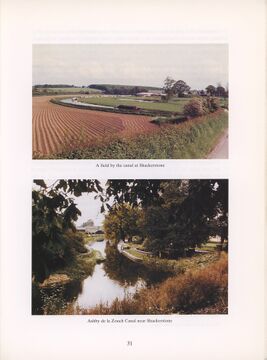
Ashby de la Zouch Canal near Shackerstone
3]
Unfortunately family finances were in a poor way, with Henry Hastings Hall
having debts which threatened to cripple him. His father, in writing to his son,
Shakespeare, explained that probably the farm would have to be sold to liqidate
these debts.
But as it appears he has no other way of meeting his liabilities it must be sold and
we must leave it. While the farm was kept there was a home for every branch of
the family but as soon as that is gone we shall be scattered.
He continued:
For myself, I must go to the Murray and I have no doubt of getting a living on it,
but I cannot start without means. Last year Frank was at the Blackwood and tho’
we had plenty of bullocks and a pair would have been quite sufficient to have got
in my crop Andn. did not think he could spare them, tho’ I should have finished
long before they began on theirs. I had 15 acres cleared and fenced but was
obliged to abandon it this year owing to the death of your dear Mama. I could
not leave Wongung/[sic] as we were some time without a female servant and now
tho’ we have got a man and his wife I am compelled to superintend the most
trifling parts of the housekeeping and with all my care and attention it is as much
as І can keep things going on decently ... We are all well. Laetitia[sic]* expects
an increase to her family shortly. I believe they are getting on well at the
Blackwood Frank and And. desire their love to you all.
Henry Edward and his sons had continued to work the 200 acres at Mandurah
and as predicted he shifted down there to live. In a letter written a few months later
he informed his son Shakespeare of his exploits at the Mandurah block:
I have been here for a month getting my wheat thrashed and I have now, with
much trouble, got it to Cooper’s Mill. I have been getting some more land
cleared and I shall put in 14 acres of [indecipherable] this season.
However, in the following April, Henry Edward died of cancer of the throat —
just thirteen months after Sarah Theodosia. He was aged 69 years and was buried in
the East Perth Cemetery.
Henry Hastings sold Wongong in 1860 to a butcher called Liddelow for £1050 and, as forecast by his father that if this was done the family would be “dispersed to the four winds”, they were.
In a letter penned in April 1860, Henry Hastings said:
... Anderton has been very ill, he was in bed for a few days and got so brought
down that a week after he had apparently recovered we went to Mandurah
- Her name was often spelt this way.
32
together and in the evening he had two successive fainting fits at Sutton’s and we
thought he was dying — I was recommended to bleed him in the absence of a Dr.
but I refused as I considered he was too weak already, the next day Dr. Bridges
came down on his way South and he said if I had bled him under the
circumstances I should have killed him.
Ander is going to live at my father’s late place and I think can do far better than at Woongong|sic] — I am going to the Blackwood to look at a “Run” I have heard of, the only one to be procured. I have to leave my place [Wongong] on the 1st May — I expected to get more for it, but thought it better to sell than to lose more time over it. Today I performed the melancholy duty of removing my poor Mother's coffin from Woongong[sic] to the Perth Cemetery. I started at 3 o'clock in the morning and did not get it all over until 1 o'clock noon. She now rests at the side of our other dear parent.
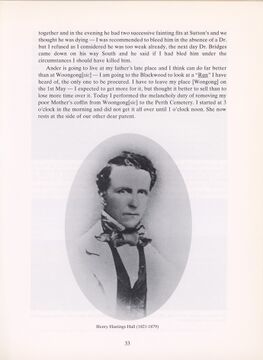
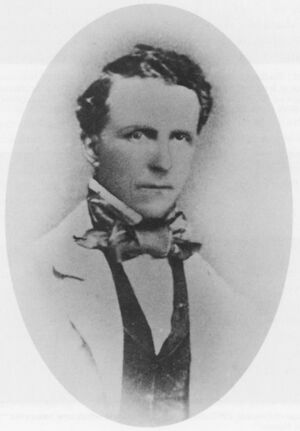
Henry Hastings Hall (1821-1879)
33
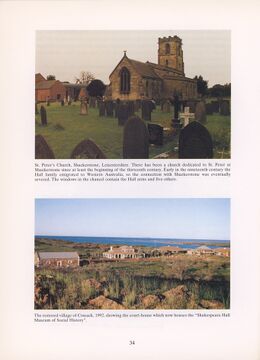
St. Peter's Church, Shackerstone, Leicestershire. There has been a church dedicated to St. Peter at
Shackerstone since at least the beginning of the thirteenth century. Early in the nineteenth century the
Hall family emigrated to Western Australia, so the connection with Shackerstone was eventually
severed. The windows in the chancel contain the Hall arms and five others.
The restored village of Cossack, 1992, showing the court-house which now houses the “Shakespeare Hall
Museum of Social History”.
34
Before Henry Hastings handed over Wongong he commented in a letter to his
brother, William Shakespeare Hall: “... Since Tom Peel Junior’s troubles his sister
was on a visit here. She is nicely educated and very ladylike, but I fear has too much
Peel blood in her veins. She has gone to Mandurah.”
Henry Hastings Hall lived more or less permanently at Mandurah from the 1860s, but he had troubles too, as an advertisement in the Perth Gazette signifies:
£5 REWARD
On the 22nd instant, the hut occupied by my
bullock-driver, at McGibbon's timber
station, Southern Estuary, was destroyed by
fire. 330 Ibs. of flour and a bag of sugar were
first abstracted, and the hut and certain
valuable articles burnt, to prevent suspicion
of robbery. The above reward will be paid on
conviction of the incendiaries.
H.H.Hall,
Murray, Nov. 26th, 1864.
He had earlier thought seriously about starting up a fishing industry at
Mandurah, using Aboriginal labour. His intention was to salt, pickle and smoke
mullet, snapper and herrings, and export the product to the Eastern Colonies.
Although there were plenty of fish, the local colonial market was not large enough
and Mandurah was too remote from the other markets to make the project viable.
The idea therefore fell through, and it was not until 1878 that commercial fishing
commenced here — fish canning in a factory erected by the colonial entrepreneur,
Charles Broadhurst. Henry Hastings had mentioned his idea of exporting processed
fish in a letter to his sister Sarah Bracher in May 1862, but had also given other
news:
Poor old Capt. Hester died on the 5th current and Capt. Shaw on the following
day. Old Flarty is dead and Mrs Woodward at the age of 72 — all in a week —
the old settlers go off always at the close of Summer. Ander and his wife have
gone to live with Mrs Lazenby* for the present so S and I are keeping bachelor's
hall. We were very near taking Mrs Sutton's property for which we offered her
£400 a year but she is very hard to deal with ... During the past summer she lost
by fire some splendid farm buildings and a quantity of corn valued at £500. I was
at the fire and feared at one time it would reach us — our house is only some 300
yards from her's...the season has been very dry, but we have lately had rain
and are busy ploughing — it will take us a month — we grow wheat, barley and
rye.
- Lucy Lazenby was Anderton Hall's first wife — she died in childbirth, leaving six children.
25
By 1862 Anderton Hall and his wife, Lucy, had moved from Mandurah to
Beenyup (now Byford) and Henry Hastings and Shakespeare were working the
Mandurah property. As mentioned, Henry Hastings offered Mrs. Sutton £400 a year
for her land but she could not make up her mind whether to lease it to him or not
— he made the comment that she was “wealthy”. He went on to say, “During the
past summer she [Mrs Sutton] lost by fire some splendid farm buildings and a
quantity of corn valued at £500. I was at the fire and feared at one time it would
reach us — our house [Halls’ Cottage] is only 300 yds from her.
Thos. Peel Snr. died at Mandurah at the end of 1865 but Dora had to wait out the customary period of mourning before her long courtship with Henry Hastings could be ended with their marriage. There was a notice in the /nquirer, which stated: “On the 28th April [1867] at Mandurah, by the Rev. J. S.Price, [the marriage] of Mr. H. H. Hall of Dedallumup Murray to Dora Anne only surviving daughter of the late Thos. Peel Esq. of Mandurah”.
Henry Hastings appeared to be very active in civic affairs at Mandurah but received a dreadful set-back two years after his marriage when a bushfire destroyed his home and the whole of the contents, which the Inquirer stated, *. . . included valuable books, furniture, clothing etc." He reported to his sister:
You may believe how destitute we were after the fire when I say my wife had not
a single article of change of clothes, until I went to Town and got materials for
her to make up — The cheapest necessities of every description or requirement
had to be bought and it will be long — if ever — we have anything better...
Presumably all the Peel inheritance of Dora would have been lost as well. In
1871 Henry Hastings referred in a letter to his sister, to the combination of the after
effects of the fire and his foolishness in being mixed up in two bankruptcies —
which compelled him to borrow £200 — the interest on which amounted to £50 per
year. He continued:
... even with this large property our income from all sources is not £100 a year
... I sold Dedallah and the other land to young Sutton, a nephew of the old folks,
who has all their property — if I had kept it longer the interest would have
swallowed it up. I am still living on the place but am preparing to build a cottage
on my wife's property." Several people about here owe me money which I
cannot get, but they can supply me with material and labour — otherwise I could
not build. We have built a nice new Church nearly opposite Dedallah.** The
Bishop consecrated it on the 25th of last month. We collected funds, formed a
building Committee of which I was Chairman and had no contract work — while
the building was in hand it took a good deal of my time for 18 months. The
Bishop gave us very great praise. The Minister from Pinjarrah gives us one
- “This means that a member of the Hall family lived in the cottage until the year 1872.
- 'l'he church was consecrated as Christ's Church, Mandurah, in October 1871.
36
Sunday every month and I, by appointment of the Bishop, conduct the service at
all other times — so you see I’m a piece of a parson after all!” Our population
is increasing very slowly — I could almost count the heads of families on my
fingers — but 10 years ago there was not one young child in the place, now there
are 50 — “and the cry is still they come!”. When I build it will be close to the
scene of the fire, where the late Mr. Peel lived when you were here...
Will you ask your esteemed husband to get me a printed form or copy of Road Board Bye-laws. I have been on the Murray Board for the last three years.**
One of the children that came was his own son, Leslie:
As you begin your letter about our little boy I may tell you, he is a fine, beautiful
child and runs about well and as full of mischief as a monkey — I wish he was as
old as your boy. In all probability I shall not be alive to see him a man.
ANS
oo Уы SS Ree
Christ’s Church, Mandurah, c.1895
- This relates to the fact that he had been earmarked for the living of Shackerstone church if the family
had remained in England.
- He was the first secretary of the Murray Roads Board, fulfilling the job in an honorary capacity.
37
Leslie Peel Hall, born 1870
Writing again to his sister, Sarah Bracher, in May of 1872, Henry Hastings said:
“We are gradually recovering from our terrible disaster — but it will be long before
we cease to feel the effects. I have nearly completed a new house near the site of the
old ruins. I should not have built at present but have to leave the place I am living
in. I was not well prepared for the outlay and it will keep me very short of money
for the next two years — my wife who is of a more prudent nature than I, would
have been content to live in a slab hut or anything else until we could better afford
the expense, but I told her I did not expect to live many years and wanted for my
allotted term to live in comfort. Besides the bare idea of an estate of 22,000 acres
and positively not one decent house on it...”
In another letter he said: “My wife seldom writes to any one, nor do I unless downright compelled. We have no time and very little of a pleasant nature to relate. lw.
In 1877 he mentioned that Suttons were milking 60-70 cows and that “we are all well, Thank God. I am not as strong as a year or two back. I think I carried my last
38
bag of flour from the cart to the house a week or two ago, it was as much as I could
manage..." Henry Hastings was right about his failing health as he died of cancer
in September of 1879 (after nine weeks in Perth Hospital), aged only 58 years. In a
family letter of the time it was stated *. . . Mrs. Hall and the boy, Leslie (aged nine
and their only surviving child), were in Perth about 5 weeks and a few days after the
funeral returned to Mandurah. I hear she has let the property to [Mr] Tuckey and
intends to live in either Perth or Fremantle...” In a letter to her sister-in-law, Dora
remarked:
There are railways commenced at Perth and so many strangers there, they tell
me it is difficult to find any suitable accommodation for me and Leslie ... I fear
I shall miss the pure sea air, still I believe I require a change and Leslie ought to
be at school.
Both Henry Hastings and Dora were buried in the Hall plot in the East Perth
Cemetery, and the tombstone lists five members of the family as being buried there.
Dora lived at 982 Hay Street, West Perth, just below the present Parliament House
in a cottage called *Baxtley"*, and she died in October 1907 at the age of eighty.
Sarah Louisa Bracher née Hall (1819-1898)
- Baxterley — one of the properties the Hall family had owned back in England.
39
The fortunes of the six brothers and sisters of Henry Hastings Hall would make
another story. All of Sarah Theodosia and Henry Edward’s children married:
Sarah Louisa to George Bracher — They lived for some years in Mauritius, but
returned to Australia and lived in Victoria. Sarah died in Bendigo.
Henry Hastings to Dora Peel, daughter of Thomas Peel of Mandurah.
Letitia to Robert Hester, Inspector of Police at Albany and later a farmer.
Theodosia to Edward Hester (brother of Robert) of “Blackwood Park”, who
became a very successful farmer.
William Shakespeare and James Anderton married sisters — Hannah and Lucy
Lazenby, daughters of George Lazenby, Perth’s first Town Clerk. Both brothers
lived and died in the North West.
Edward Frank to Annie Carpenter. They lived at Northampton.
Letitia Hester née Hall (1822-1877)
40
FAMILY TREE
OF THE
HALL FAMILY
They came to Swan River on 20th February 1830, per ship PROTECTOR
Henry Edward HALL — Sarah Theodosia BRANSON
b. circa 1790 bpt. 16/4/1793 Shackerstone
m. 22/11/1815 at St. Michael's
Coventry
d. 20/4/1859 d. 17/2/1858 (Wongong, WA)
Sarah Louisa = George Bracher
b. 5/11/1819 b. circa 1861
m. 12/6/1846
d. 1910 d. 8/2/1891
Issue: 1 son 4 daughters
Henry Hastings = Dorothy Anne Peel (Dora)
b. 12/6/1821 b. 1827
m. 28/4/1867
d. 8/8/1879 d. 18/10/1907
Issue: 1 son
. Laetitia = Robert Hester
b. 2/9/1822 b. 1824
m. 5/5/47
d. 1/7/1877 d. 11/11/1875 (Roebourne, WA)
Issue: 3 sons 2 daughters
. Theodosia Sophia = Edward Hester
b. 12/10/1827 b. 1820
m. 4/5/1847
d. 1898 d. 11/1898
Issue: 3 sons 5 daughters
Wm. Shakespeare = Hannah Boyd Lazenby
b. 3/12/1825 b.1849
m. 11/1868
d. 11/2/1895 d. 1911
Issue: 3 sons (one died young) 2 daughters (one died young)
. James Anderton = 11/10/1858 1. Lucy Lazenby
Issue: 4 sons 2 daughters
b. 1829 17/12/1872 2. Lillian Helena Bruce
Issue: 3 sons 3 daughters
d. 9/12/1888
Edward Frank = Anne Carpenter
b. 20/2/1832 b. 1865
m. 25/1/1882
d. 18/8/1886 d. 27/10/1950
Issue: 1 son 2 daughters
H. M. Wilson
18/3/1994
41
William Shakespeare Hall (1825-1895) ` Theodosia Sophia Hester née Hall (1827-1898)
Edward Frank Hall (1832-1886) James Anderton Hall (1829-1888)
It must be remembered that early photographs may be misleading in the way they portray people.
Inevitably they appear to have solemn and severe expressions. Having one’s likeness taken was
considered to be a very formal affair, but in reality they were often jovial and pleasant-looking
individuals. Also, the low sensitivity of the film in those days required subjects to remain motionless for
several minutes — too long to sustain an unchanging smile.
42
It could be suggested that in assessing the life of the pioneers, perhaps it would
be as well to remember that it was not the timid and contented who took the
enormous gamble of emigrating to the “other side of the world” in the first place.
Because they are our forebears we are inclined to expect them to be of superhuman
proportions — of pure intention in all things, of altruistic charity, kindly, gentle and
brave. In fact, of course, they were real people (with real virtues and real failings)
who lived real lives, and sank or survived in a new world of unimagined hardship.
Henry Edward and Sarah Theodosia Hall were one such couple who put their all at
risk and lost (if regarded from a materialistic viewpoint). When one contemplates
the tranquillity and unchanging beauty of Shackerstone in Leicestershire, one can
understand a little of what they must have given up for 30 years of unremitting work
and hardship — and at the end nothing remained except a small debt to the
Government. In telling something of their story an attempt has been made to
convey an appreciative realization of their efforts in the early development of
Western Australia.
43
Hall Family Crest
The motto reads: “The die is cast”.
ISBN 0646183974


